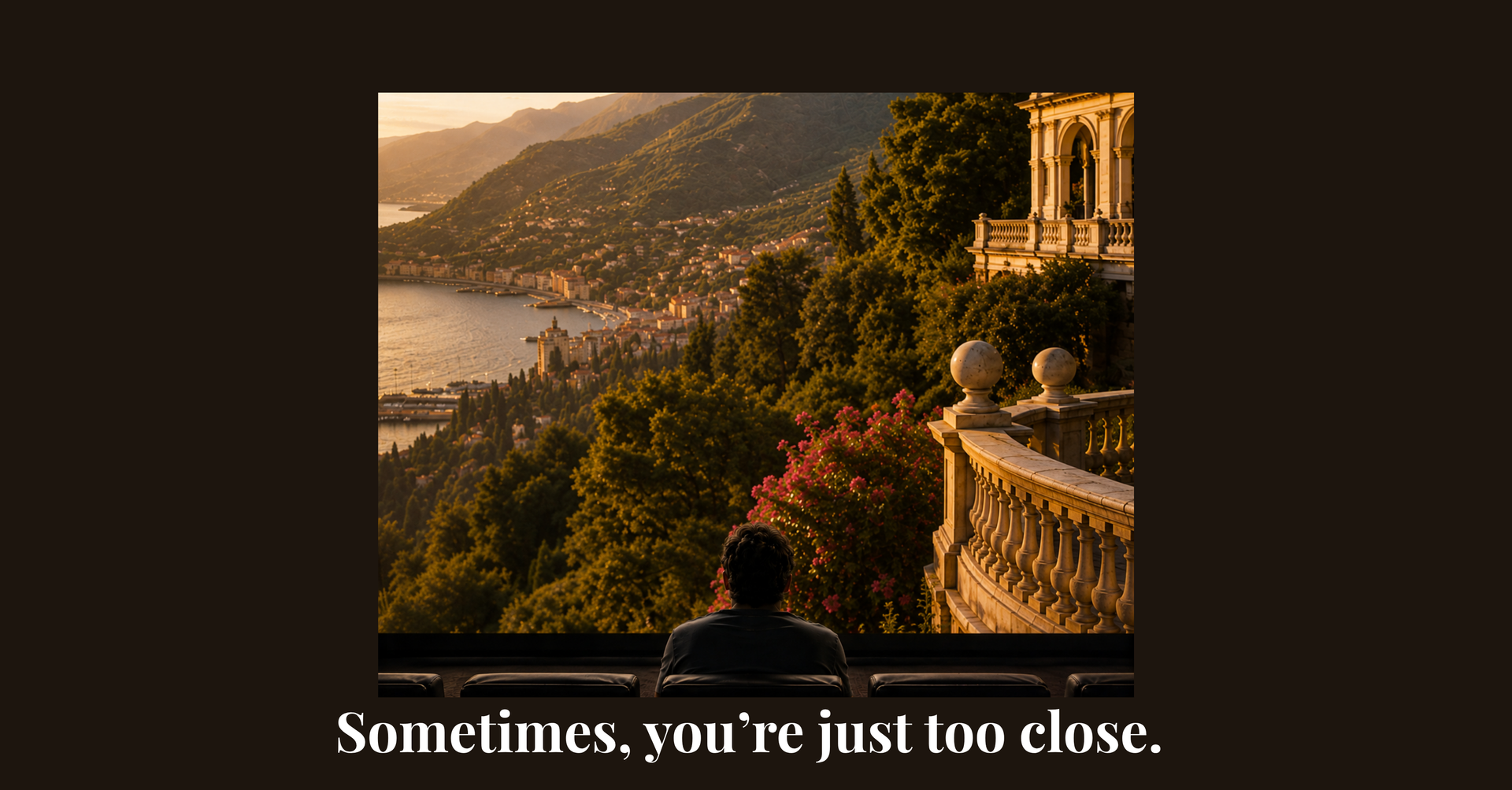
You Don't Control Your Life. You Control Your Choices.


John Ortiz
Creator of My Protection Score™ Assessment I help families & business owners find what’s unprotected before life does. | Protection Strategist
September 1, 2026
“I just need to get things under control.”
I’ve said it. You’ve probably said it.
Work. Money. Family. Business. Health. The calendar.
We say it like control is something we can eventually achieve.
But with all the outside noise... do you really think you control your life?
I don't.
I think I control certain decisions. I control how I respond. I control some of the preparation I put in place.
But my life? There are way too many variables.
If you have a job, somebody else can make a decision tomorrow that affects your income. If you own a business, add customers, employees, vendors, sales and expenses to the list. If you have children, you already know they occasionally have their own plans.
Then there is traffic. Your health. The car. The house. Other people.
And time.
You can put every one of those things on a calendar, build a spreadsheet, create a plan and feel pretty good about where you're headed.
Then Tuesday morning happens.
A few days ago, I started my car at 7:15 in the morning.
It started shaking.
Great. Like I don’t have enough problems already.
My daughter needed to get to school. I needed the car again that afternoon to pick her up. Then she had swim practice. None of those things disappeared because my car had decided Tuesday was a good day to have a problem.
Fortunately, I had dealt with something similar before. I knew enough to get my daughter to school safely and then take the car to a mechanic I trust.
He needed to keep it until Thursday.
Now I had another problem. I still needed transportation.
I could rent a car. I could start rearranging schedules. Then my daughter's godmother heard what happened and offered me her second car.
Problem solved.
Not the car problem. That still needed to be repaired.
The life problem.
I didn't control what happened that morning. What I had were choices.
Some came from experience. Some came from having a mechanic I trusted. Some came from having enough financial flexibility to rent a car if I needed one. And one came from a relationship.
I didn't build any of those things because I knew my car was going to start shaking at 7:15 on a Tuesday morning.
That's the point.
You can't anticipate every problem life is going to throw at you. And I don't think you should spend your life trying.
The better question is whether you've built enough depth around your life that when something doesn't go according to plan, you still have choices about what happens next.
Not Everyone Starts With the Same Choices
The choices available to you today depend partly on what you've already built around your life.
Maybe you're thinking, Of course you had choices. You could rent a car. You had a mechanic you trusted. Someone had another car you could borrow. That's great for you, John, but I'm living paycheck to paycheck. I don't have six months sitting in the bank. I can barely handle what I have now.
Before I told you what to do, I'd want to understand your story. Because when someone says, “I don't have a choice,” I've learned that can mean very different things.
Sometimes it means exactly what it says. The numbers don't work. The resources aren't there. Something happened that overwhelmed whatever preparation existed.
That's real.
But sometimes another choice exists. You just can't see it from where you're standing.
I met a woman at a networking event who inquired about making some side-hustle income. She was married with two children, working for a friend and wasn't making enough money.
So I started asking questions. What have you done before? What are you good at? What kind of responsibilities have you handled? What experience do you actually have?
As she answered, I started seeing something she wasn't seeing.
Her income was limited.
Her capability wasn't.
I happened to know someone looking for a person with her experience. The position paid considerably more than she was making, so I encouraged her to have the conversation.
She interviewed. Then the problem changed.
Her friend didn't want her to leave, and now she felt guilty. She came back to me and essentially asked, How can I do this to my friend?
Out of curiosity, I asked her, “Is your family your friend's first responsibility?”
No, she replied.
“Who is your first responsibility to?”
“My family.”
There was her choice.
I didn't tell her to leave. I didn't tell her what decision to make.
I changed the comparison.
She ultimately took the job. What I find interesting about that story isn't that she made more money. It's that nothing about her capability changed between one job and the other.
She didn't wake up smarter. She didn't suddenly acquire years of experience.
She already had it.
What changed was her perspective. Someone standing outside her everyday life asked different questions and saw another possibility.
Sometimes we don't lack choices. We lack the ability to see them from where we're standing.
Some Choices Come With a Cost
Having choices doesn't mean you're going to like any of them.
Sometimes you know exactly what the alternative is. You just don't want it.
I've had conversations with people who tell me they're struggling financially. We look at the numbers together, and the problem isn't mysterious. Too much money is going out.
At that point, there are only two broad levers.
Either less goes out, or more comes in.
Simple doesn't mean easy.
Reducing what goes out could mean changing the car you love, living somewhere different, or looking at all those subscriptions that somehow became permanent members of the family. Maybe Uber Eats doesn't need to know you by first name.
Or spending may not be the real problem. Income may be.
That could mean asking for a raise, changing employers, developing another skill, starting a side business, or finding another way to create income.
I don't know which one belongs to you. That's why I wouldn't guess.
But there is an important difference between “I don't have a choice” and “I don't like my choices.”
The second one is about stakes and sacrifices.
What matters enough to keep? What are you willing to change? What are you trying to protect? What does each alternative cost you?
If you look at your numbers and decide the expensive car matters enough that you're willing to sacrifice something else to keep it, that's your decision. It's not my job to take your keys.
But now you understand the trade.
That's different from believing the trade doesn't exist.
Sometimes the hardest part of creating choice isn't finding another option. It's deciding what you're willing to give up to have it.
And Doing Nothing Is Still Something
There is another choice available in almost every difficult decision: do nothing.
Sometimes that's the right decision. You may not have enough information, yet. The timing may not be right. After looking at everything, you may decide the sacrifice isn't worth the benefit.
Fine.
But I don't believe a non-decision is neutral.
A non-decision is a decision.
You decided not to make a different decision. And while you're doing that, life keeps moving.
The mortgage doesn't pause. Your children don't stop getting older. Your business doesn't stop changing. Your health doesn't freeze. Your career doesn't wait.
Time doesn't care that you're still thinking about it.
That's not a reason to rush. It's a reason to include doing nothing in the comparison.
If I make this change, what happens? If I make that change, what happens? And if I change nothing, what happens?
Put all three in front of you.
Then decide.
Sometimes “Someday” Sounds Responsible
I met a young man through networking who loved talking with me about advanced life insurance strategies. Every time I saw him, we seemed to end up having another conversation about what he eventually wanted to build.
After about the third conversation, I finally asked him, “How much life insurance do you have?”
“None,” he replied.
That surprised me. He was 29 years old. Married. Two children. Healthy.
He had a clear picture of what he eventually wanted to do. He just hadn't done anything yet.
He told me he couldn't afford the strategy he really wanted.
Fair enough.
So I asked what he ultimately wanted his family to have. He had a large number in mind.
Then I changed the comparison.
I told him to imagine, just for a moment, that he never got the opportunity to put that ultimate plan in place. Would his wife rather have the large amount he intended to create someday, or would she rather have a smaller amount that was actually there?
He stopped.
You could see the comparison land.
He said she would want what was there.
Of course she would.
Then we did something surprisingly simple. We looked at what he could actually afford. Not what he assumed he could afford. Not the ultimate strategy.
Today.
What was possible turned out to be substantially better than he thought, and he and his wife eventually put meaningful protection in place.
I am not telling you that story because this article is secretly about buying life insurance.
I'm telling you because I see the same thinking everywhere.
People wait until they can do something perfectly. They'll start saving when they can save enough for it to matter. They'll look for another job when the perfect opportunity comes along. They'll start the business when everything is ready. They'll fix the spending when they make more. They'll deal with it when things settle down.
Sometimes waiting is the intelligent choice.
But sometimes the ideal future solution becomes the reason we never implement the useful present one.
Those are different things.
Does the choice available today have to solve the entire problem?
If you can improve the trajectory by 2%, maybe that's enough for today. Then another 2%. Then another.
Let time do some of the work.
Preparation Doesn't Guarantee the Outcome
I don't want to leave you with the impression that if you prepare correctly, everything works out.
It doesn't.
There are things that happen to families that no reasonable amount of preparation makes easy. Sometimes every available choice is hard.
Sometimes the problem is bigger than the resources around it. Sometimes life changes in a way you never could have anticipated.
Preparation doesn't make you invincible. Money doesn't make grief disappear. Insurance doesn't make illness go away. An emergency fund doesn't guarantee that the emergency will conveniently cost less than whatever you saved.
That's not what any of this promises.
What preparation can sometimes do is much less dramatic.
And much more useful.
It can keep one difficult event from unnecessarily becoming five difficult events.
If the problem is your health, maybe it doesn't immediately have to become a housing problem too. If you lose your job, maybe you don't have to take the first job offered because the mortgage is due next Friday. If the car breaks, maybe it can remain a car problem instead of becoming a work problem, a school problem and a transportation problem.
You haven't controlled what happened.
You've created some room around it.
And inside that room are choices.
That's When Protection Starts Meaning Something Different
Most people hear the word protection and naturally think about what they're protecting themselves from.
That's understandable. But I think there's another side to it.
What are you protecting for?
Maybe you're protecting the ability to leave a job that stopped being right for you, or the ability to take your time finding the next one. Maybe it's the ability to start a business, help someone you love without destabilizing your own family, or spend more time with your children.
It could be the ability to make less money for a while because something else has become more important.
Or simply the ability to say no.
Or yes.
Or not yet.
That's why I don't think the purpose of preparation is to build some giant wall around your life so nothing can get through. That's playing defense all day long.
I don't want to live that way.
I want to live.
The preparation sits underneath the life.
And here's the strange part: you may not know what you're preparing for when you build it.
That's okay.
You don't have to predict the exact future. You don't have to know which Tuesday the car will break, when an opportunity will appear, or exactly how your priorities may change five or ten years from now.
You build some depth. You create some flexibility. You leave yourself more than one path.
Then life happens.
And sometimes, only then do you discover what all that preparation made possible.
I Learned That Lesson in a Different Way
When my wife and I got married, we didn't plan to have children.
For years, our life reflected that decision. I was running businesses with national footprints and spending an enormous amount of time traveling. Eventually I sold those businesses because I wanted more time with my wife.
Then life changed.
We had a daughter.
Suddenly, the question wasn't what I could do professionally. I could have easily slipped back into being a business owner in the same industry I exited.
The question was what I wanted the life around my work to look like.
I valued being able to pick up my daughter from school, make dinner and put her to sleep every night.
That choice had a cost. I could have pursued opportunities that probably would have produced considerably more income.
But income wasn't the only thing I was comparing anymore.
Time mattered differently.
Being present mattered differently.

My definition of what I was trying to protect had changed.
The preparation and choices I had built earlier didn't control the direction my life took. They gave me enough room to respond when the direction changed.
And that may be the part of choice we overlook.
Sometimes choice isn't there merely to help you survive something bad.
Sometimes it allows you to recognize that something else has become more important.
Control and Choice Are Not the Same
You do have control over some things: your decisions, your preparation, what you're willing to change and how you respond.
Those things belong to you.
But the rest of life?
There are simply too many variables.
And I don't think accepting that makes you powerless. I think it allows you to stop wasting energy trying to control what was never yours to control and put that energy somewhere more useful:
building choices around the things that matter.
You may never get your life completely under control.
I’m not sure that was ever possible.
But you can look at the life you have today and ask a different question:
If something changes tomorrow, how many choices will I have?
Maybe the goal isn’t controlling what happens next. Maybe it’s building enough depth into your life that when the unexpected happens, you still have some say in what happens after that.